When you’re in a mental crisis, every minute counts. If you’re hearing voices, can’t stop thinking about ending your life, or feel like you’re losing control of your thoughts, you don’t need to wait for an appointment. Psychiatrická pohotovost exists precisely for moments like these - when you can’t wait, can’t handle it alone, and need help now.
Kdy je čas zavolat psychiatrickou pohotovost?
Not every bad day means you need emergency care. But there are clear signs when you should act immediately. If you’ve had strong, recurring thoughts of killing yourself - especially if you’ve made a plan or have the means - call for help right away. The same goes if you’re hearing voices that tell you to hurt yourself or others, or if you’re completely unable to take care of basic needs like eating, drinking, or using the bathroom.
Physical signs matter too. If you’ve cut yourself, taken too many pills, or are acting violently toward yourself or others, this isn’t something to handle at home. You’re not weak for needing help. You’re smart for recognizing you’re beyond your limits.
Even if you’re not in physical danger, long-term symptoms can be just as urgent. If you’ve been unable to sleep for more than two weeks, can’t go to work or school for over a week, or feel constant panic that won’t go away, you’re in a crisis too. These aren’t just "bad phases." They’re signals your brain is overwhelmed.
Jak se dostat k psychiatrické pohotovosti?
In the Czech Republic, you have three main ways to get help - and none of them require a referral from your GP. Unlike in Germany, where you need a doctor’s note just to see a psychiatrist, here you can walk in or call directly.
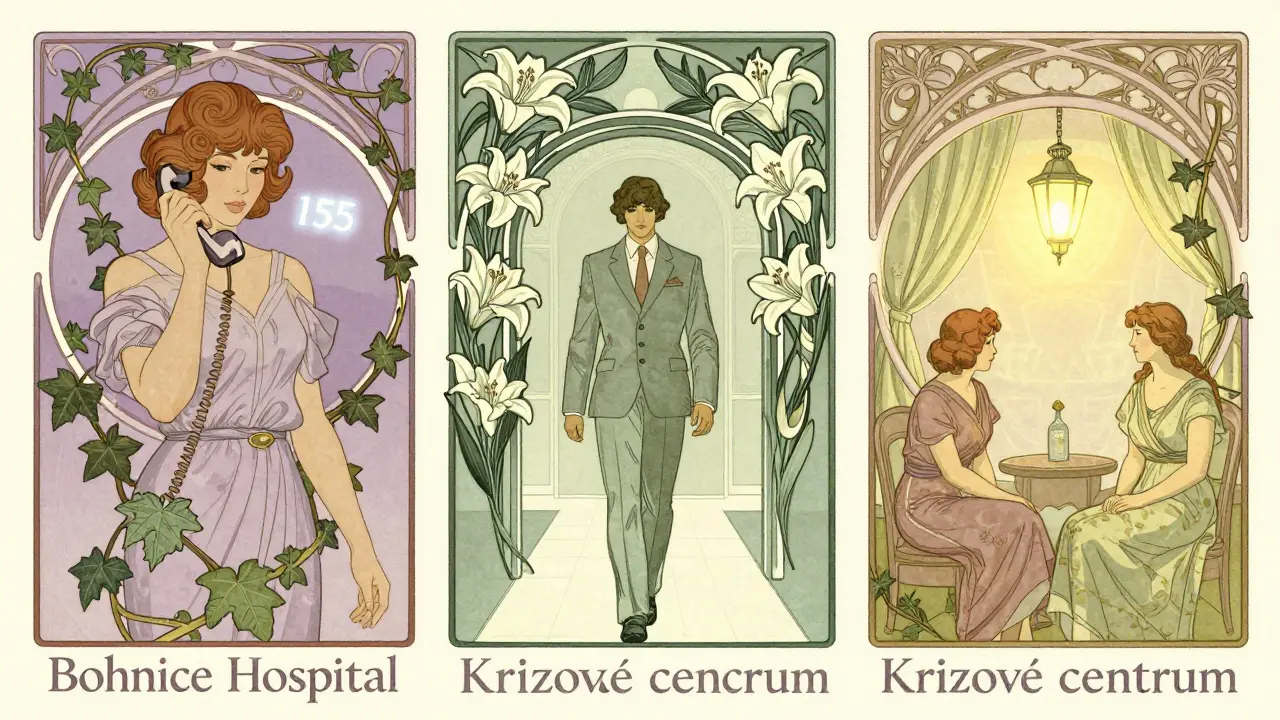
1. Zavolejte 155 (Zdravotnická záchranná služba)
If you’re in immediate danger - suicidal, psychotic, or violent - dial 155. Paramedics will come, assess you, and take you to the nearest psychiatric emergency unit. They’re trained to handle these situations. Don’t hesitate because you’re afraid of being "taken away." Their goal is to stabilize you, not punish you.
2. Navštivte psychiatrické oddělení v nemocnici
Every regional hospital has a psychiatric emergency unit. In Prague, go to Psychiatrie Bohnice, 1. LF UK, or Národní ústav duševního zdraví v Klecanech. In Ústí nad Labem, head to Krajská zdravotní a.s. In Ostrava, visit Psychiatrie FNO. These units are open 24/7. You don’t need to call ahead. Just show up and say you’re in crisis. They’ll prioritize you.
3. Kontaktujte krizové centrum
Krizová pohotovost is different from hospital care. These centers offer short-term stays (usually 3-7 days) for stabilization without full hospitalization. They’re perfect if you’re overwhelmed but not in immediate physical danger. In Moravia, try CNS-Centrum Třinec or Psychiatrická nemocnice v Opavě. In Moravian-Silesian Region, they’re more common than in other parts of the country.
Co se stane, když dorazíte?
When you arrive, you’ll be seen by a psychiatrist or psychiatric nurse. They’ll ask about your thoughts, feelings, recent events, and medical history. Don’t hold back. They’ve heard it all. The goal isn’t to judge you - it’s to understand what’s happening so they can help.
You might be asked to stay overnight for observation. This isn’t punishment. It’s protection. Many people leave feeling relieved, not trapped. In fact, 82% of users in a 2022 survey said the speed of response in life-threatening situations was "excellent."
If you’re stable enough to leave, you’ll get a plan: medication, follow-up appointments, or referral to a community mental health team. You might even be given a phone number for a local crisis line. The system isn’t perfect, but it’s designed to keep you alive.
Co platí za pomoc?
Emergency psychiatric care is covered by public health insurance. You pay nothing for the emergency visit, hospital stay, or medication prescribed on-site. This is different from private psychologists, who charge 800-1,500 Kč per hour. You don’t need to have insurance for years - even if you’re newly insured, you’re entitled to emergency help.
Outpatient follow-up, however, is where delays happen. While emergency care is fast, waiting for a regular appointment can take 4-6 weeks. That’s why emergency units are so important - they bridge the gap.
Co dělat, když pomoci nechcete?
Many people avoid help because they’re scared, ashamed, or think they’ll be locked up. But here’s the truth: In the Czech Republic, you can’t be hospitalized against your will unless you’re an immediate danger to yourself or others - and even then, it’s rare and legally protected.
If you’re unsure, call a crisis line first. In Prague, try 116 123 (Telefon důvěry). In Moravia, call 116 117. These are free, anonymous, and staffed by trained volunteers. You don’t have to commit to anything. Just talk.
And if you’re worried about stigma? You’re not alone. A 2022 survey by ÚZIS found 63% of people with mental illness avoid seeking help because they fear judgment. But every person who walks into a psychiatric emergency unit is someone’s child, parent, friend, or coworker. They’re not "crazy." They’re human.
Problémy systému - a co se děje?
Yes, the system has gaps. There’s only one psychiatrist for every 35,000 people in some regions - far below the WHO-recommended 1:10,000. In Prague, it’s 1:12,500. In Moravian-Silesian Region, it’s 1:28,300. That’s why waiting lists are long.
And yes, sometimes you’ll wait three hours in the ER. One woman in Ostrava shared on Facebook that she waited while her self-harm wounds bled. That’s unacceptable. But it’s not the rule - it’s the exception.
Good news: The Czech Ministry of Health launched the National Mental Health Strategy 2023-2030. By 2030, they plan to hire 25% more psychiatrists, open 12 new crisis centers, and cut waiting times for outpatient care to under two weeks. They’re also expanding telemedicine - in 2022, over 42,000 remote psychiatric consultations were done, up 315% since 2020.
Co můžete udělat teď?
If you’re reading this because you’re in crisis - call 155. Go to the nearest hospital. Don’t wait until tomorrow. Don’t think you’re a burden. You’re not.
If you’re worried about someone else - don’t wait for them to ask. Call 155. Take them to the ER. Sit with them. Say: "I’m here. We’ll go together."
If you’re just trying to learn - save these numbers:
- 155 - Zdravotnická záchranná služba (24/7)
- 116 123 - Telefon důvěry (Praha a většina krajů)
- 116 117 - Krizová linka (Morava)
- 111 - Národní ústav duševního zdraví (Klecany)
- 284 016 144 - Psychiatrie Bohnice (Praha)
- 477 113 152 - Krajská zdravotní (Ústí nad Labem)
You don’t need to be alone. You don’t need to suffer in silence. Help is here. And it’s waiting for you - no matter how bad it feels right now.
Můžu si přijít na psychiatrickou pohotovost bez doporučení od lékaře?
Ano, v České republice je možné navštívit psychiatrickou pohotovost bez doporučení. Není potřeba žádný papír od praktického lékaře. Stačí přijít do nemocnice nebo zavolat 155, pokud je situace akutní. To se liší například od Německa, kde je doporučení povinné.
Je psychiatrická pohotovost zdarma?
Ano, akutní psychiatrická péče je hrazena z veřejného zdravotního pojištění. To zahrnuje návštěvu pohotovosti, krátkodobou hospitalizaci a léky předepsané na místě. Nemusíte platit nic, i když jste si pojištění založili nedávno. Jediné, co může být placeno, je následná ambulantní péče, kde může být čekací doba delší.
Co se stane, když jsem v krizi, ale nechci být hospitalizován?
Hospitalizace bez souhlasu je možná jen v případě, že jste nebezpečný pro sebe nebo ostatní - například pokud máte plán sebevraždy nebo jste agresivní. Většina lidí, kteří přijdou na pohotovost, je vypuštěna po krátké hodnocení. Nejsou "zavření". Jsou stabilizováni a posláni na následnou péči. Pokud nechcete hospitalizaci, řekněte to lékaři - většinou najdou alternativu.
Kde najdu krizové centrum v mém regionu?
Krizová centra jsou většinou při větších nemocnicích. V Praze: Národní ústav duševního zdraví v Klecanech. V Ústí nad Labem: Krizové centrum Krajské zdravotní, a.s. V Ostravě: CNS-Centrum Třinec pro Frýdek-Místek, Psychiatrická nemocnice v Opavě pro okresy Nový Jičín, Opava a Bruntál. V Karviné: NsP Havířov. Všechna tato místa mají 24/7 přístup pro akutní krize.
Proč je tak dlouhá čekací doba na ambulantní péči?
V Česku je značný nedostatek psychiatrů, zejména mimo Prahu. Průměrně je 1 psychiatr na 35 000 obyvatel, zatímco doporučená norma je 1:10 000. To znamená, že i když je pohotovost funkční, následná péče je přetížená. Ministerstvo zdravotnictví plánuje zvýšit počet psychiatrů o 25 % do roku 2030 a snížit čekací doby na méně než 2 týdny.